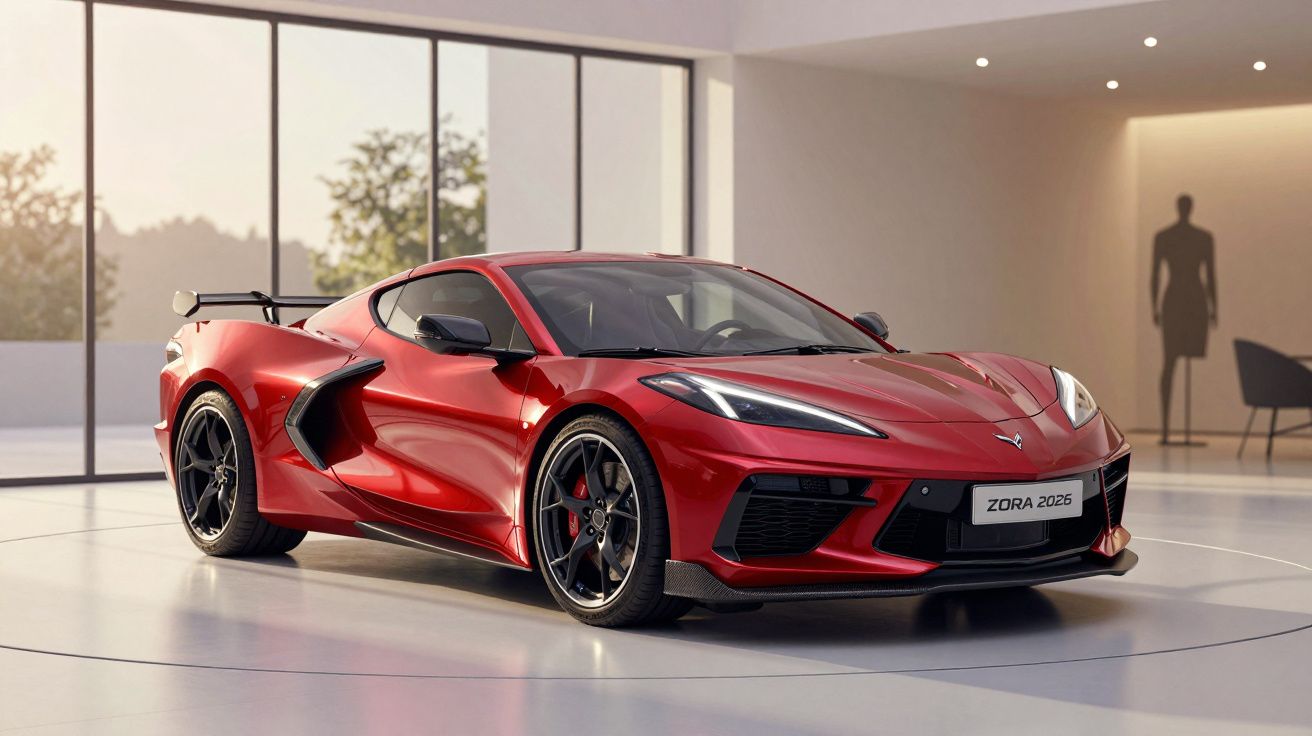
2026 Chevy Corvette Zora: Chevrolet’s Next Supercar Vision
The 2026 Chevy Corvette Zora is among the most talked-about cars on the planet-and it’s easy to see why. It isn’t simply another sports car; it’s a serious high-performance machine blending advanced tech, striking styling, and massive power. Named for Zora Arkus-Duntov-often known as the “Father of the Corvette”-this model nods to his long-held goal of building a true world-class supercar under the Chevrolet badge.
A Tribute to a Legend
Zora Arkus-Duntov was the engineer who consistently urged Chevrolet to make the Corvette quicker, tougher, and more sophisticated. The 2026 Corvette Zora channels that mindset by pushing the Corvette range into new territory. It’s not just a visual statement-it’s designed to deliver performance that can compete directly with exotic names like Ferrari, Lamborghini, and McLaren.
Power That Defines the Word “Supercar”
Behind the seats-rather than under a traditional hood-is where the real surprise is expected to live. The 2026 Zora is widely rumored to pair a twin-turbocharged V8 with a hybrid electric system. Combined output could exceed 1,000 horsepower, potentially making it the most powerful Corvette ever produced. With that kind of force on tap, 0–60 mph runs under 2 seconds are within the realm of expectation, putting it alongside the quickest cars in the world.
Chevrolet engineers aren’t chasing horsepower alone. The hybrid layout is expected to sharpen launches, raise efficiency compared with a purely gas setup, and deliver instant electric torque. In other words, it aims to mix classic American muscle character with modern electrified speed.
In the broader supercar world, this kind of gas-and-electric pairing is becoming a proven formula. Brands like Porsche and Rimac have helped reshape expectations around electrified performance-showing how electric assist, battery management, and traction control strategies can translate into repeatable acceleration and track capability. That industry momentum gives helpful context for why Chevrolet is expected to take the Zora in a hybrid direction.
Just as important is the ecosystem surrounding such a high-output car. Specialized tire and brake suppliers such as Michelin and Brembo often play a major role in helping supercars put extreme power down safely, especially when track use is part of the mission. While the final specifications haven’t been confirmed, it’s common for flagship performance cars to rely on top-tier third-party components to support cooling, grip, and stopping power at very high speeds.
A Design That Turns Heads
From the first look, the 2026 Corvette Zora appears as if it’s been pulled from the near future. It keeps the sleek mid-engine proportions introduced with the C8 generation, but with a more aggressive posture, tighter lines, and aero details meant to be both dramatic and functional. Expect a front end with larger intakes, a sculpted hood, and bold LED lighting, while the rear is likely to feature a wide diffuser and a large spoiler to increase downforce. The idea is that every contour does a job-helping the car stay planted even when the speed climbs.
Technology That Enhances Every Drive
Inside, the Zora’s cockpit is expected to feel closer to a fighter-jet layout than a traditional sports car cabin. The design is anticipated to prioritize the driver, with premium materials such as leather, carbon fiber, and aluminum throughout. It should also include the latest Chevrolet infotainment interface, featuring a crisp display, updated navigation, and smartphone connectivity.
Along with comfort and polish, the Zora is expected to bring serious performance-focused assistance. From adaptive suspension to track-oriented drive modes, the car should be configurable for different situations-whether that’s a relaxed city cruise or a full-attack lap on a road course.
A New Era for the Corvette Brand
The 2026 Chevy Corvette Zora is positioned as more than a new model-it’s a statement about the direction of American performance. It suggests Chevrolet intends to challenge Europe’s best while keeping a distinctly Corvette identity. By combining combustion power with electrification, the Zora aims to prove that excitement can grow alongside new technology rather than disappear.
Many analysts also suspect this car could represent the high-water mark for the Corvette’s gas-powered chapter before Chevrolet leans further into electrification. If that prediction holds, the Zora may be remembered as one of the most significant Corvettes ever built.
Expected Price and Release Date
Although Chevrolet hasn’t officially locked in pricing, the 2026 Corvette Zora is expected to start around $200,000 or more. That places it in the neighborhood of elite supercars, yet it may still undercut many European rivals by a wide margin. The car is expected to reach showrooms sometime in 2026, and limited production is likely-boosting demand among collectors and enthusiasts.
FAQs About the 2026 Chevy Corvette Zora
What makes the Zora different from the Corvette Z06 or E-Ray?
The Zora is expected to combine the twin-turbo strength associated with the ZR1 approach and the hybrid concept seen in the E-Ray, resulting in a Corvette that’s both brutally powerful and technologically advanced. In many ways, it’s positioned as the ultimate Corvette.
Will the Zora be all-electric?
No. It’s expected to be a hybrid, using both a gasoline engine and an electric motor to enhance performance.
How fast can the 2026 Corvette Zora go?
Official figures haven’t been released, but many expect a top speed in the neighborhood of 215 mph or higher.
Is the Zora a limited-edition model?
Yes, production will likely be limited, which should make it rare and collectible for years.
Final Thoughts
The 2026 Chevy Corvette Zora isn’t just another Corvette variant-it’s positioned as the most advanced evolution of an American icon. With aggressive design, extreme performance potential, and hybrid power, it ties the Corvette’s heritage to what comes next. For enthusiasts worldwide, the Zora doesn’t merely look exciting-it feels like history being written in real time.
Comments
No comments yet. Be the first to comment!
Leave a Comment